Leadership · Operating model · Decision systems
Leading data products to trusted decisions
The work is bigger than selecting a model. A data leader aligns the decision, delivery system, evidence standard and operating workflow so that technical capability changes what the organisation can do.
Executive takeaway
Turn uncertainty into responsible decisions.
Across betting, sports data, AI content, gaming and infrastructure, the recurring failure mode is not a lack of clever analysis. It is a break in the chain between the question, the data, the evidence and the operating decision. My leadership approach makes that chain explicit and gives each stage an owner and a promotion standard.
Direction
Choose problems with a named decision, a clear owner, material upside and an understood downside—not a vague instruction to “use AI”.
Trust
Agree what evidence is required before the work starts. Evaluation, leakage controls and fallbacks are part of the product brief.
Adoption
Ship into a real workflow with monitoring, review cadence and decision rights. A notebook result without an operating path is unfinished.
Operating model
Direction → delivery → trust → adoption
I use a four-part model to keep strategy, technical delivery and governance connected. It applies to a trading signal, a computer-vision benchmark, a forecasting system or an AI-assisted editorial workflow because it is organized around evidence and decisions rather than a particular stack.
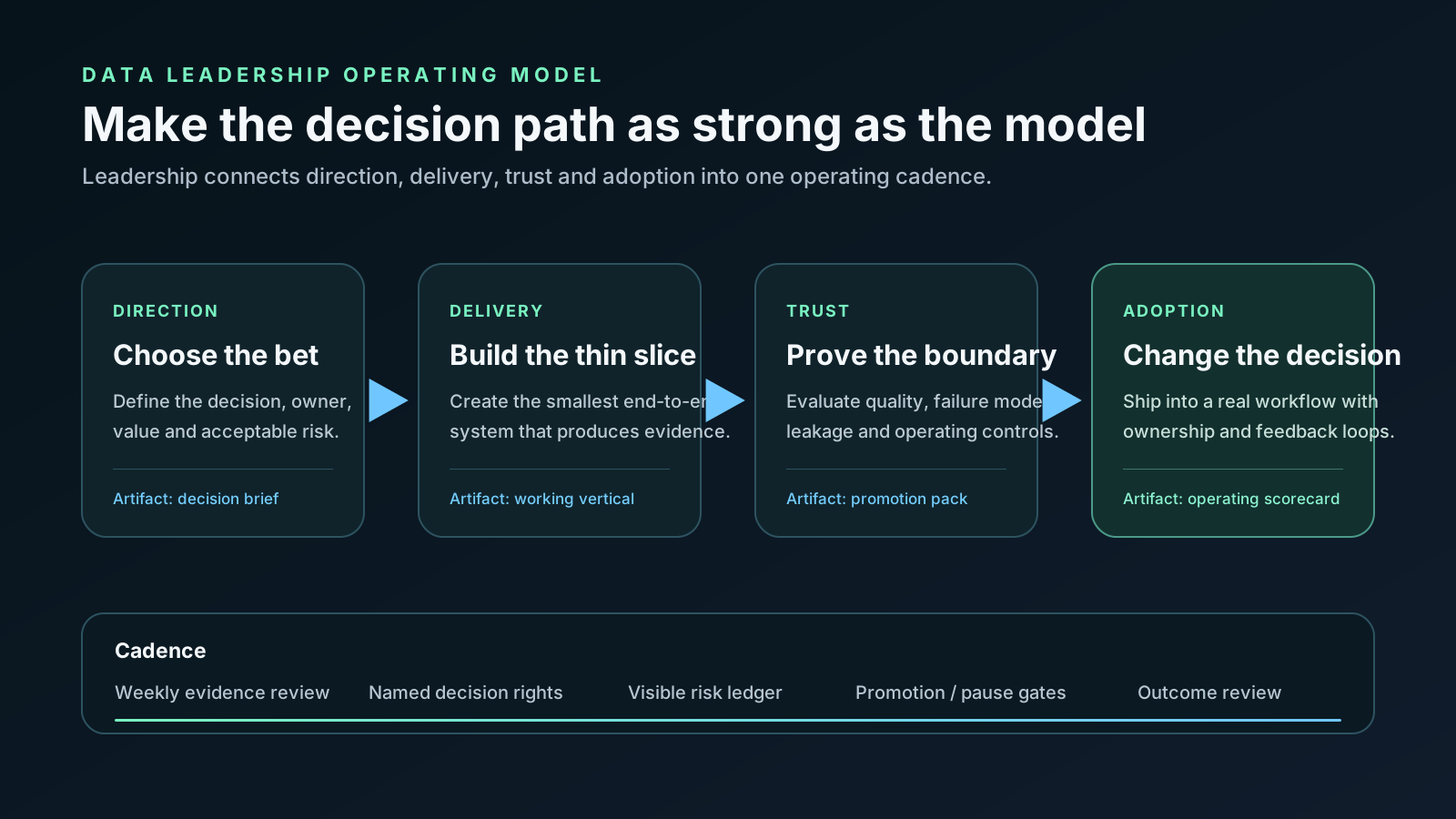
Choose the bet
Write a short decision brief: intended user, decision changed, value mechanism, risk boundary, evidence required and a reason to stop.
Build the thin vertical
Connect representative data to an inspectable output early. This reveals interface, ownership and quality problems before scale makes them expensive.
Prove the boundary
Test realistic failure modes, compare against a baseline and document where the system should abstain, degrade or route to review.
Change the workflow
Embed the output in a decision, name the operator, monitor the live behaviour and create a feedback path that can alter the roadmap.
What I own as a data leader
Four conversations, one operating model.
Commercial
What changes if this works?
Value, customer, time horizon, constraints, risk appetite and the point at which more sophistication stops paying back.
Technical
What is the dependable system?
Data contracts, architecture, baselines, interfaces, observability and the sequence that avoids premature complexity.
Evidence
Why should anyone trust it?
Reference sets, backtests, calibration, leakage checks, failure slices, human review and promotion criteria.
Organisational
Who decides and who operates?
Decision rights, team shape, hiring bar, delivery cadence, stakeholder translation and ownership after launch.
Selected evidence
One operating model, many products.
These examples stay deliberately at the level of public outcomes and reusable management patterns; they do not expose customer data, raw strategy logic or private commercial material.
Quant research
From research idea to live signal
Led a production copy-betting signal through backtesting, shadow/live validation, settlement checks and explicit promotion criteria, with P&L, exposure and risk monitoring attached to the operating decision.
Leadership proof: research governance and live controls, not only model development.
Sports data
From video to benchmarkable task
Designed the path from raw sports footage to labelled image packs, QA artifacts, validation sets and scoring contracts, using the snooker vision proof point to align product and technical stakeholders.
Leadership proof: data-product architecture, evaluation and stakeholder communication.
AI product
From prototype to a paying customer
Built Attimo’s architecture around structured event ingestion, retrieval, generation, evaluation and human review, then established a repeatable delivery shape for new sports and customer workflows.
Leadership proof: technical direction connected to commercial delivery.
Simulation & infrastructure
From model output to specification change
Led a four-person quant and data-engineering pod, combining Monte Carlo simulation, analytics pipelines and executive reporting so stress-test evidence could shape risk and product specifications.
Leadership proof: roadmap, team cadence and decision impact across modelling and platform work.
Evaluation & governance
Promotion is a sequence, not a threshold.
The evidence standard should grow with exposure. I prefer visible promotion gates that make risk legible and let a team learn cheaply before a system controls an important decision.
| Stage | Question | Minimum evidence | Typical decision |
|---|---|---|---|
| Concept | Is the decision worth improving? | Decision brief, baseline and representative sample | Fund a thin slice or stop |
| Offline | Does the approach beat the right comparison? | Held-out results, leakage review and failure slices | Enter shadow operation |
| Shadow | Does it behave on live inputs without controlling outcomes? | Latency, stability, calibration and operator review | Start limited exposure |
| Controlled live | Does the system create value within risk limits? | Outcome telemetry, fallbacks, incident path and named owner | Scale, revise or roll back |
| Production | Does it remain worth operating? | Monitoring, drift review, cost, adoption and periodic revalidation | Maintain, expand or retire |
Team & cadence
Make evidence the unit of progress
A strong team cadence distinguishes activity from learning. Weekly reviews should ask what changed in the evidence, which assumption is now weaker, what risk entered the ledger and which decision is due—not simply whether tickets moved.
Weekly
Evidence review
Compare the latest result with its baseline, inspect failures, update the risk ledger and make one explicit promotion, pause or scope decision.
Monthly
Portfolio review
Rebalance effort across proven value, enabling infrastructure and uncertain bets. Stop work whose evidence no longer supports the original thesis.
Quarterly
Capability review
Assess whether the bottleneck is data, product, research, platform or operating ownership—then hire, partner or simplify accordingly.
What I have learned
Data leadership makes good judgement repeatable.
- Strategy needs a falsifiable thesis. A roadmap is more useful when it states what evidence would change the direction.
- Architecture should expose uncertainty. Review queues, confidence, provenance and fallbacks are product features, not technical debris.
- Teams move faster with decision rights. Named owners and promotion gates remove more friction than another layer of status reporting.
- Commercial clarity improves technical quality. Knowing the user and consequence sharpens datasets, metrics and acceptable failure modes.
- Leaders should stay close enough to the work to challenge it. Technical depth matters most when it improves prioritisation, coaching and risk judgement.