AI product · Editorial workflow · Sports data
From hand history to story
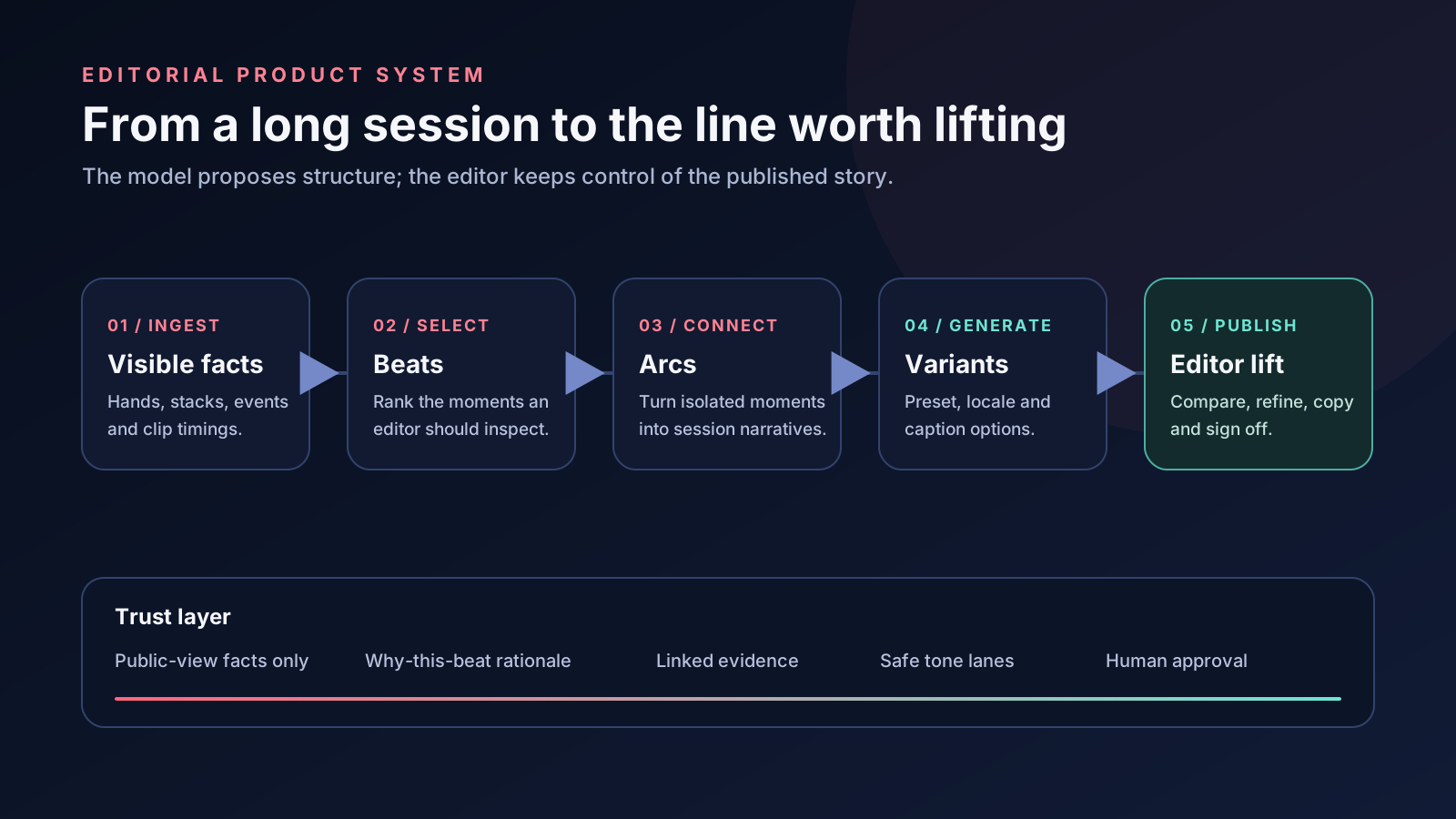
Attimo’s poker workbench compresses a long session into the moments worth inspecting, the narratives that connect them and caption options an editor can safely lift. The architecture keeps facts, selection logic and generated copy distinct.
These figures describe the illustrated workbench run, not general product-performance claims.
Executive takeaway
The scarce resource is editorial attention
A long poker session contains plenty of data but only a handful of moments with editorial value. The product decision was to organize the system around an editor’s sequence of questions—what happened, why does it matter, what larger story is forming, and which line should I use—rather than presenting a generic AI chat surface.
Faster orientation
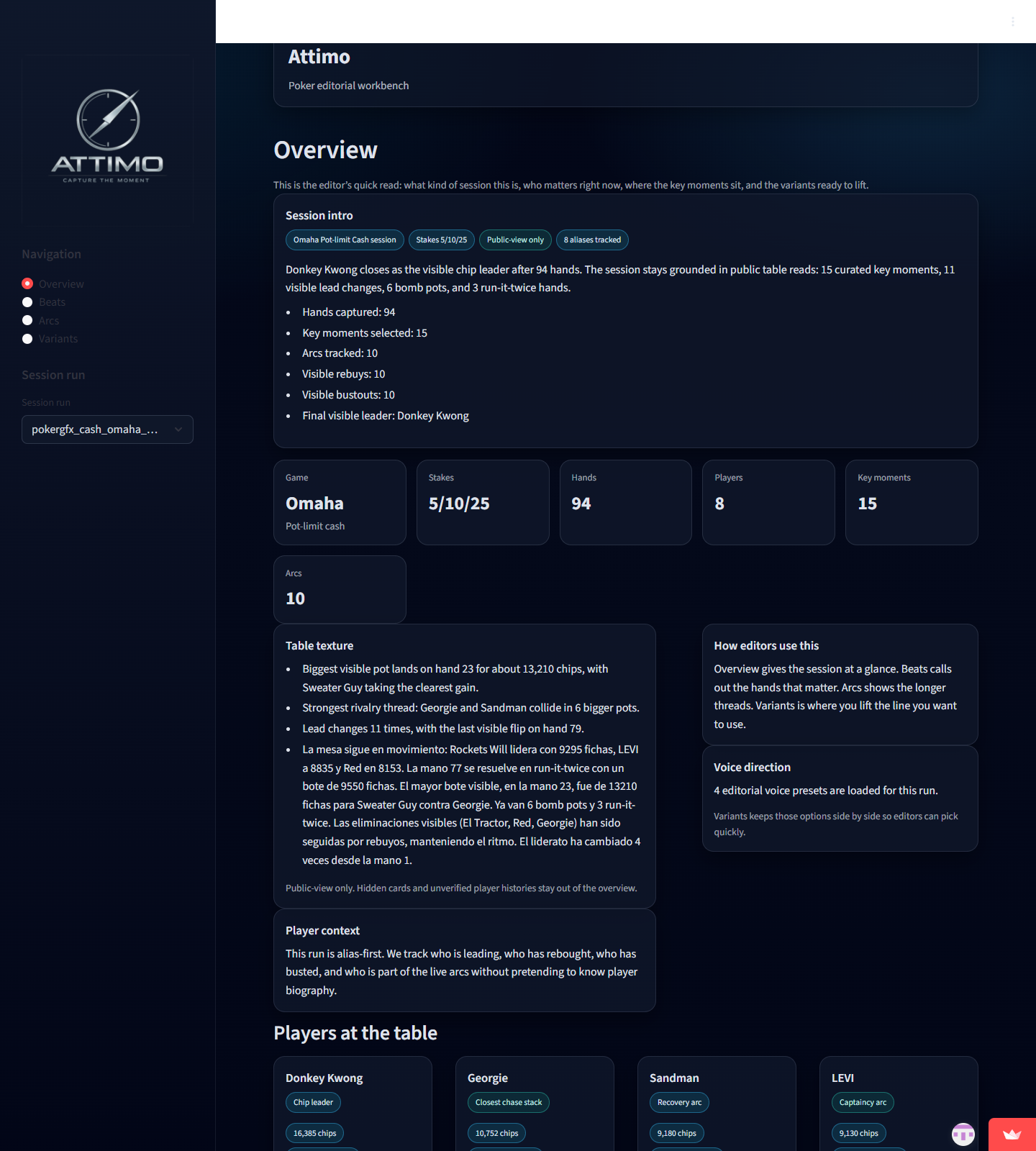
The Overview gives a compact read on session shape, visible leaders and the amount of curated material ready for review.
Explainable selection
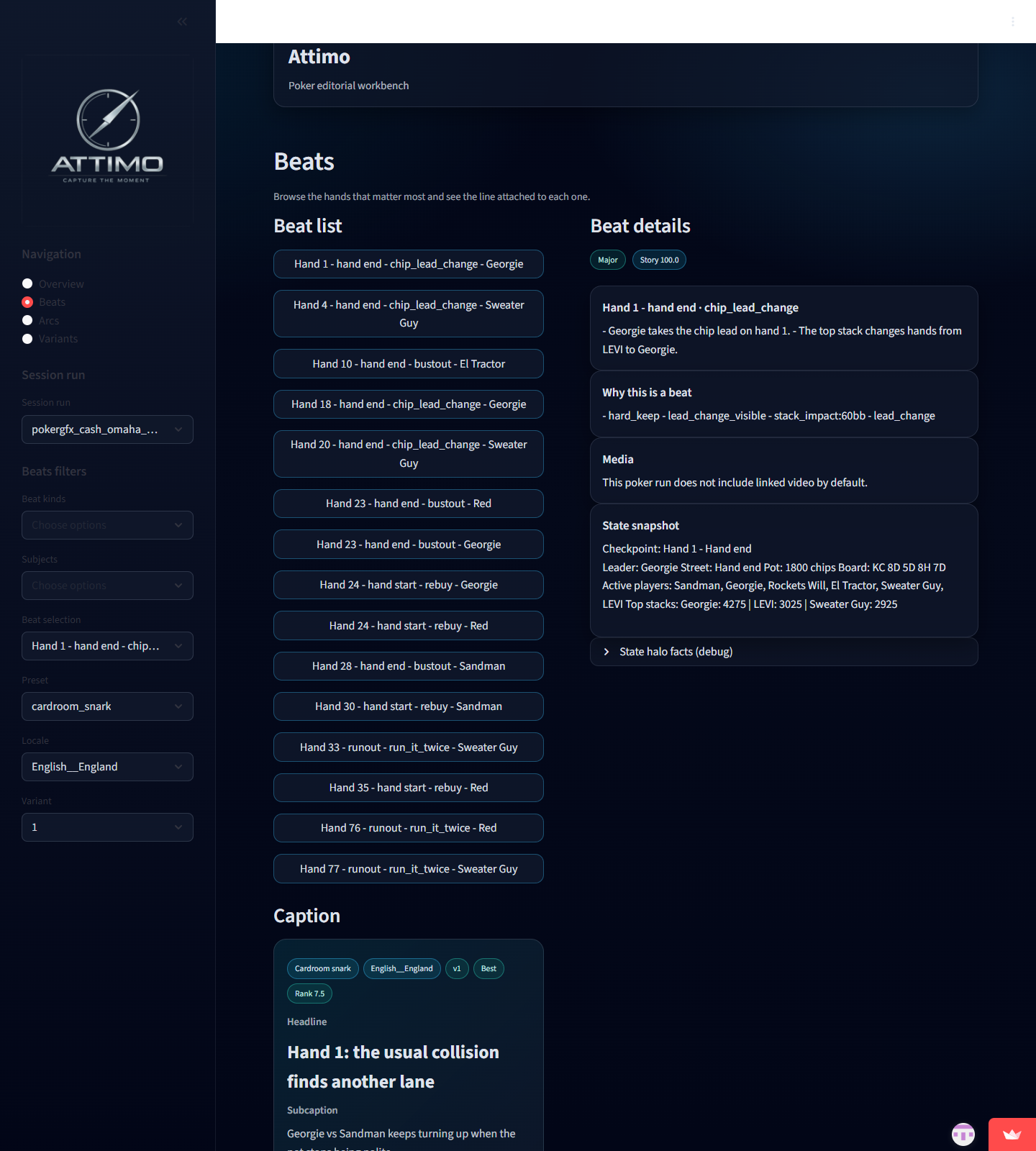
Every beat carries a reason, public facts, similar references and practical clip timings so an editor can challenge the recommendation.
Controlled generation
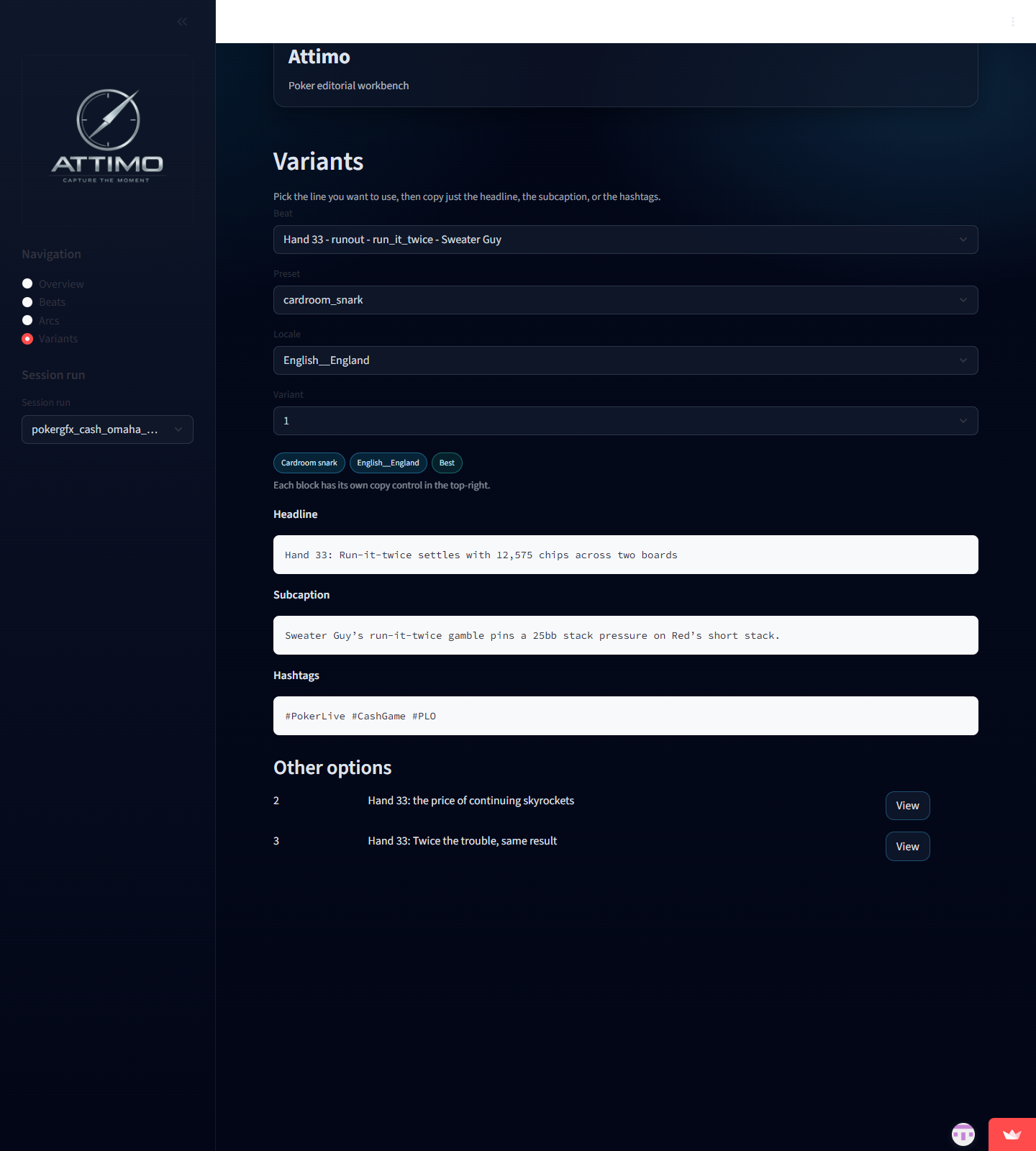
Voice, locale and caption options are explicit controls. The editor compares alternatives and makes the publishing decision.
Leadership decisions
Build around the editorial workflow.
As CTO, I shaped Attimo across event ingestion, retrieval, generation, evaluation and human review. Poker is one concrete expression of that reusable architecture. The platform-level work took Attimo from prototype to its first paying customer; this case study focuses on the poker workflow rather than attributing that commercial milestone to a particular module.
Separate facts from narrative
Visible session events form the factual layer. Beats and arcs add editorial structure. Captions sit at the final, explicitly generated layer.
Use history as reference, not mythology
Structured historic hands, ratings, tags and descriptions help prioritize live moments without inventing player biography or hidden information.
Design for the lift
Output is packaged around what an editor actually uses: headline, subcaption, hashtags, locale and clip windows—not a dump of model prose.
Product evidence
The four-part workbench.
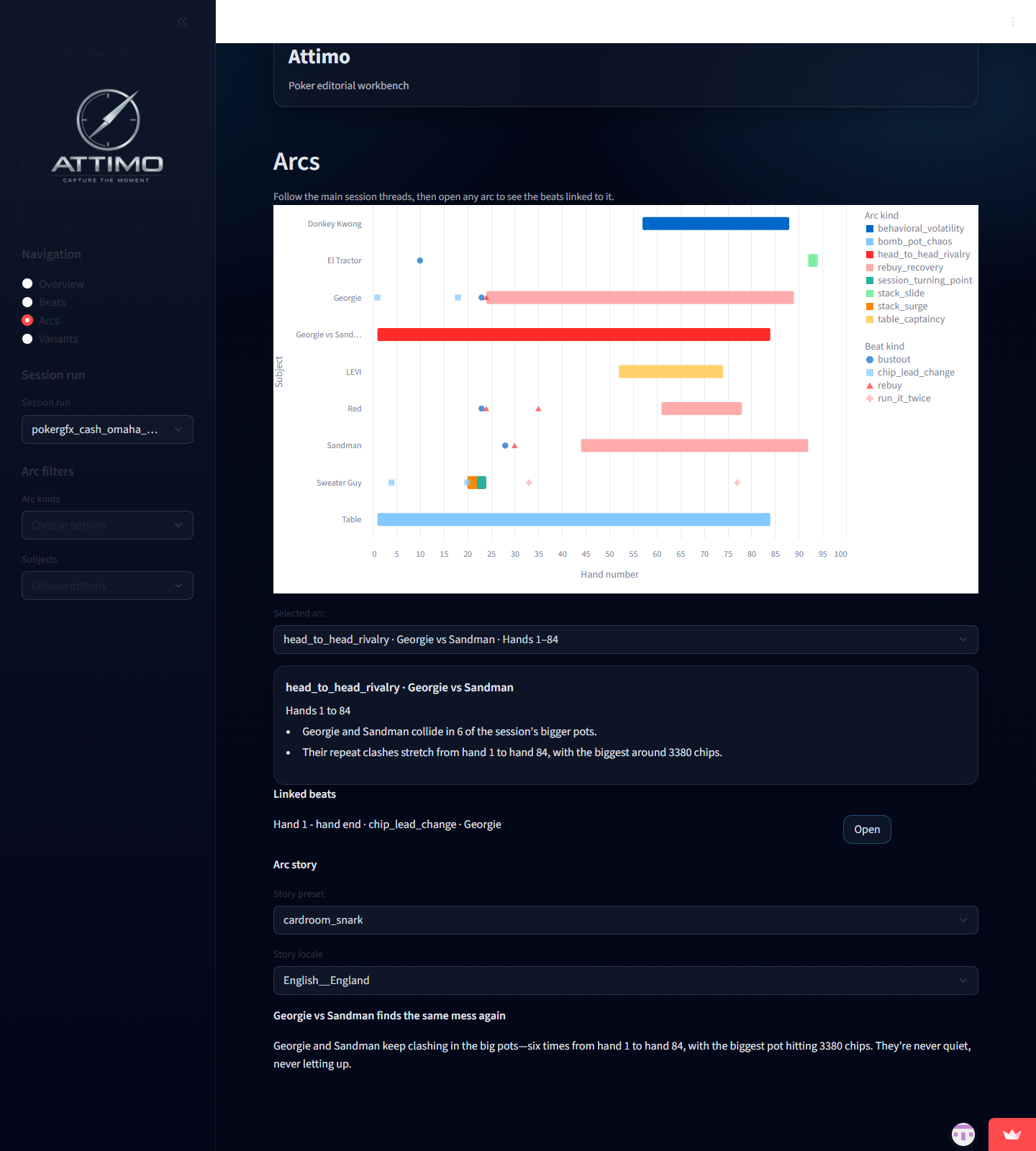
The screenshots below are the approved product views from one captured Omaha session. They are shown unchanged so the interaction model, density and editorial language can be assessed directly.
Evaluation & QA
Judge reliability, not just fluency.
A good sentence is not enough. The workbench needs to select the right moment, preserve the facts, make its reasoning inspectable and fit the real publishing workflow. Evaluation is therefore layered around the risks an editor actually carries.
| Quality dimension | Evidence | Failure response |
|---|---|---|
| Fact integrity | Visible stacks, events, boards and timings | Block unsupported details; keep hidden cards and unverified biography out |
| Moment selection | Beat rationale, impact, historic references and arc context | Demote low-value moments and expose the reason for selection |
| Editorial usefulness | Headline, subcaption, hashtags and clip windows | Keep output modular so weak fields can be replaced independently |
| Voice safety | Named presets, locale controls and poker-safe hooks | Constrain tone lanes and keep human approval before publication |
| Traceability | Beat → arc → preset → locale → variant | Retain the path used to produce every liftable option |
Outcome & lessons
A reusable editorial AI pattern.
The workbench demonstrates a repeatable product pattern: structure the domain first, use AI where judgement and language add value, and retain an explicit human decision at the publishing boundary. The same shape can travel to other sports without pretending their event grammar is identical.
- Build for a job, not an AI capability. “Find the moments I should inspect” is a better product brief than “summarize this session.”
- Intermediate objects create trust. Beats and arcs let an editor see how the system got from raw events to a proposed line.
- Generation should be modular. Headline, subcaption and hashtags can be evaluated, copied and replaced independently.
- Editorial control is a feature. Presets, locale and alternatives make the human decision faster without hiding it.